On the Ordering of Playing Card Suits
(or, why “CHaSeD” is bad for you)
 Each individual playing card is identified by the unique combination of a value and a suit. The values are numeric in nature (if we assign 11, 12, and 13 to the Jack, Queen, and King, respectively); as such, we can order them easily, exploit their odd-even nature, use them in mathematical operations, etc. The methods underlying many effects are based on this numeric property of the values. Each individual playing card is identified by the unique combination of a value and a suit. The values are numeric in nature (if we assign 11, 12, and 13 to the Jack, Queen, and King, respectively); as such, we can order them easily, exploit their odd-even nature, use them in mathematical operations, etc. The methods underlying many effects are based on this numeric property of the values.
It’s equally useful to assign such characteristics to the suits. Many people order the suits simply by memorizing an arbitrary sequence (usually one that alternates the colours): thus we have such mnemonics as CHaSeD, SHoCkeD, DuCHeSs, CoDfiSH, and HiS DeCk.
The drawback of this approach is that it simply yields an order, and fails to assign useful numeric meanings to the individual suits. Should we need the third value in a numerical sequence, we instantly know that it is a three, but when we try to do this with suits, we introduce extraneous thinking (“Let’s see, I’m using the CHaSeD order, so the third one is a Club … Heart … Spade!”). Similarly, if we wish to make use of a suit’s value for some computational purpose, we are left with questions like “What is the value of a Heart?”
An obvious analogy here is the Latin alphabet. While most people know the sequence (ABCDEFG …), and thus can quickly determine which character follows “M”, few know the numerical values of the letters (their positions), and can instantly name the 17th letter, or know at which position “R” falls.
All of this is far from ideal. For playing cards, though, the problem is easily resolved, by exploiting the natural numerical order suggested by the standard French suits, indicated by the points or lobes in their shapes, as depicted here:
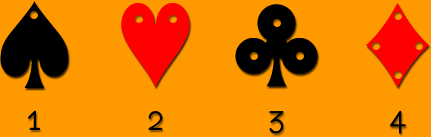
This particular ordering (which corresponds to the SHoCkeD mnemonic, though that’s a less useful way to recall it) has additional memorable significance. Spades are widely considered the #1 suit (hence the decorative Ace of Spades). The major suits (cf., Contract Bridge) are together, and precede the minor suits. The even suits are red, and the odd suits are black: black being the “odd” colour makes sense, as black isn’t really a colour (it’s the absence of colour). Further, the black symbols themselves are somewhat odd, enjoying limited recognition by non-card-players; the Heart and Diamond, on the other hand, are basic, universally recognized shapes.
Consequently, this is my personal choice — and strong recommendation — for the most effective playing card suit order. The concept dates back at least to the J. Russell Duck (aka “Rusduck”) publication of “Spades Hearts Clubs Diamonds” in Phoenix magazine (Issue #255, May 1952), pg. 1020. Once the most prevalent ordering used by European magicians, it has of late been supplanted there by the much inferior CHaSeD sequence (a victory of imitation over imagination, with a consequent loss of functionality). But once you adopt and internalize it, you will often be reminded of its advantages, and immediately and forever know that the third suit is a Club.
      … Doug Dyment … Doug Dyment

|